Trade
Buy low, cross, sell high — then chain the run into a circuit that laps unattended. Prices rot while you are away, so a quote is a snapshot of a world that moves.
Capital, and the prices every other career reads.
An idle space-trading game where you never leave the station.
The premise
You grow clones of yourself, train them over real time, seat them in ships, and dispatch them on long-running missions — trade routes, mining ops, exploration, escort, smuggling, piracy — through a shared persistent galaxy where other players' clones are doing the same, and where a freighter crossing lawless space can be caught in a pirate's net.
The galaxy is alive without other players. NPC convoys run real trade routes. Pirate clans set real ambushes. Factions patrol the ring, something is pressing outward from the dead heart of the galaxy, and buried in Precursor ruins is the story of where your clone technology actually came from.
Two to ten minutes, a few times a day. Collect the results, read the interesting ones — a haul that slipped a pirate net, a rare scan — then send everything back out.
Unlock a clone slot or a hull class. Finish a long skill. Push a corporation project. Answer the ecology — a Swarm push, a depleted field, a trade lane that moved.
The yards
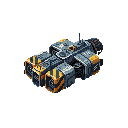
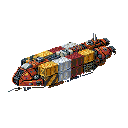
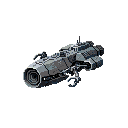

What a ship does should be readable in its outline; who built it should be readable in everything else. Four yards, one constrained palette.
The careers
Buy low, cross, sell high — then chain the run into a circuit that laps unattended. Prices rot while you are away, so a quote is a snapshot of a world that moves.
Capital, and the prices every other career reads.
Prospect a field, drill a seam until the rock is finished, and run a hauler out to meet the barge rather than making it stop.
The raw material every chain starts from.
Fly dark hexes, survey what you find, and follow the thread it leaves — a worked find points at one specific live site somewhere else on the chart.
The claims the other four careers work.
Take a contract that already names its target, run it down, and clear the hex. Set a net of your own, if you would rather be the problem.
Safety — and the lairs that stop being everybody's problem.
Refining and manufacturing. Specified in full, down to the rule that destruction is the sink the whole economy drains into — and not one line of it written yet.
Eventually, the reason the other four keep going.
Nobody has to play all five. The point is that a player who picks one is still buying from, and selling to, the four they did not.
The client
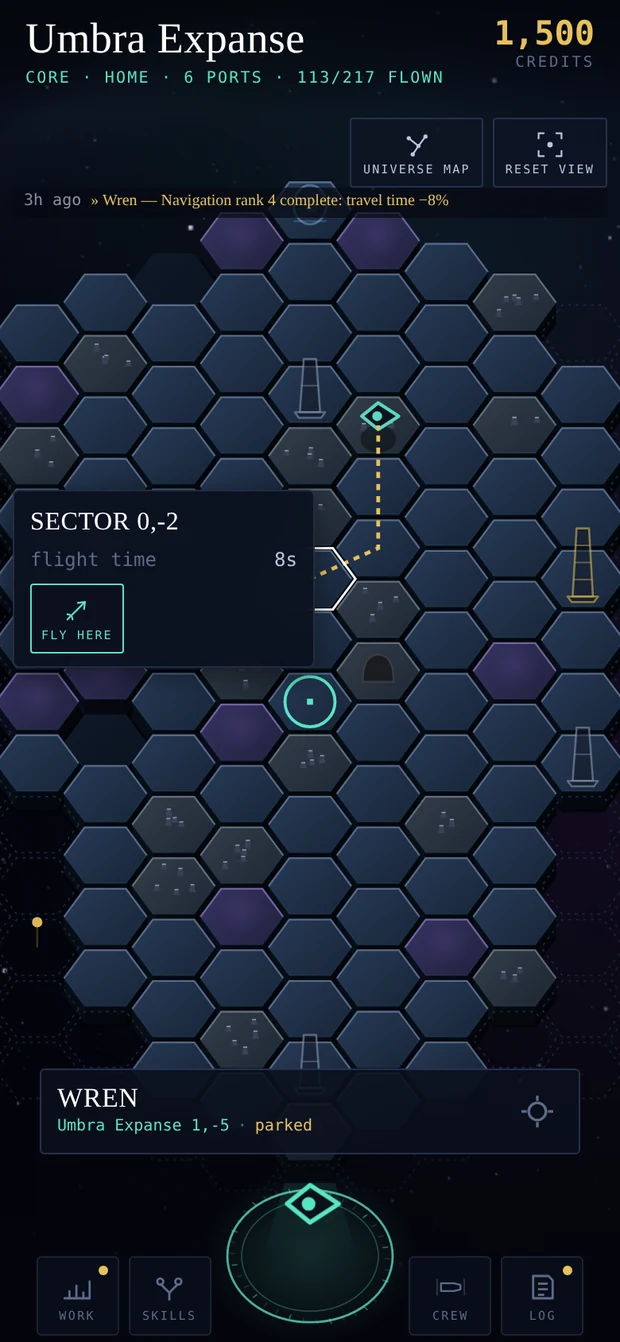
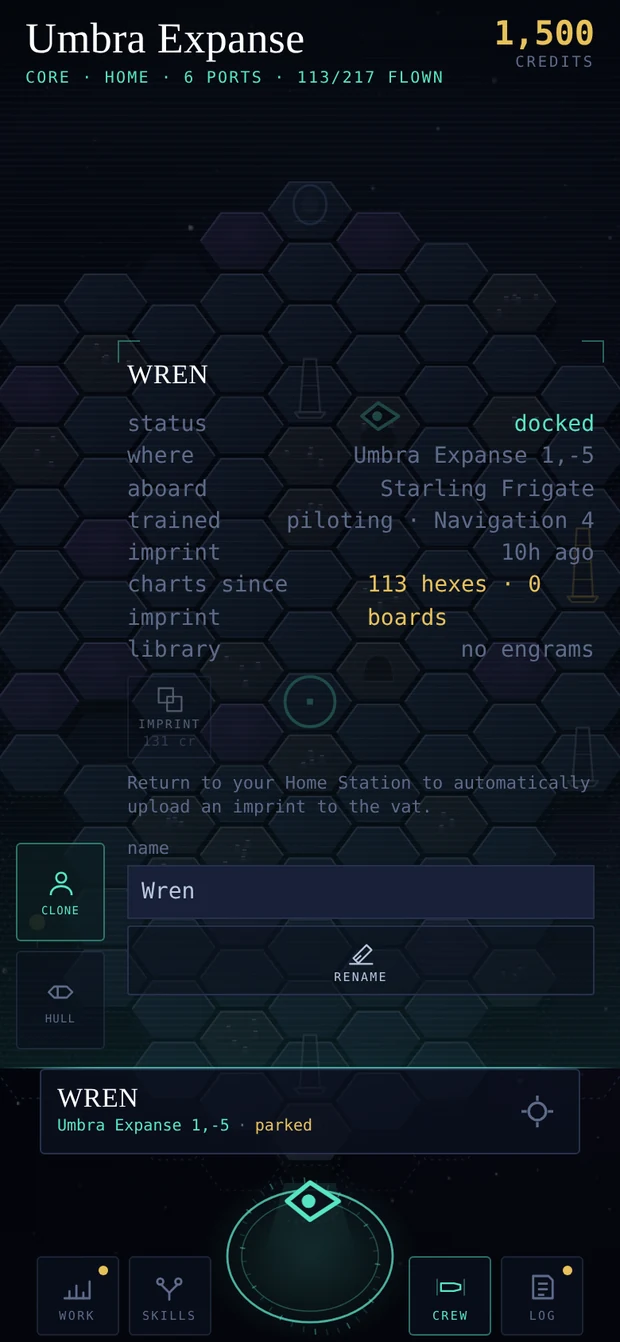
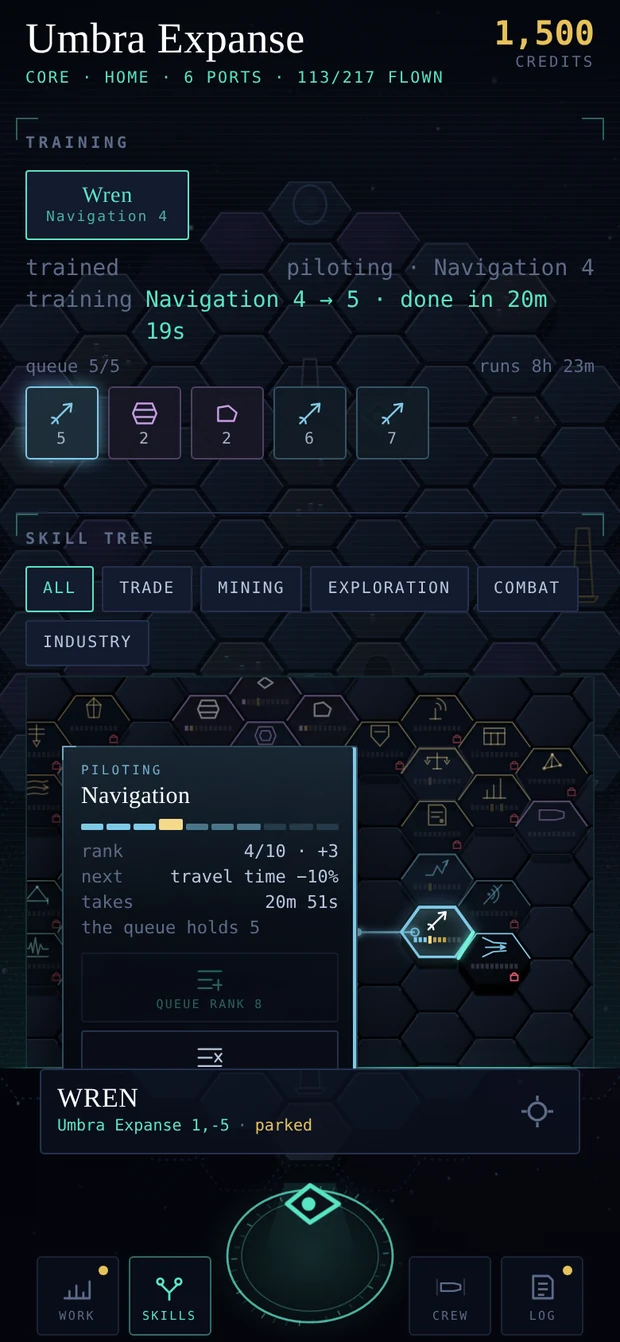
Captured from the current build, on a phone-width screen. It is an alpha: rough edges, numbers that are still moving, and a clock deliberately running faster than it will ship.
Design pillars
Skills train and missions run in real time. Sessions are short decision bursts; the game plays out between them.
No turn economy, no action points. Your throughput is capped by clone slots — never by the hours you can afford to grind.
Nothing requires two players' time windows to line up. Everything another player can do to you resolves against your standing decisions: route, fit, escort, insurance, backup cadence.
The galaxy must be fun and dangerous at population one — convoys to rob, pirates to dodge, patrols to fear. Other players multiply a living world; they are never the missing organ it can't live without.
Pirate heat rises, fields deplete, the Swarm spreads, the contract board rotates. The optimal answer keeps moving. If a check-in ever reduces to login-and-collect, that is a design bug.
Safe space is truly safe and modestly profitable. Contested and lawless space pay better, because things are allowed to hunt there.
Monetization sells those three and nothing else. No gacha. Variance can be reduced for money; upside cannot be bought; risk can never be reduced to zero.
Inspiration
Port trading, sector navigation, and pirates waiting on the lanes.
Real-time skill training, clones, zoned security, and loss that matters.
Ship roles and the outfitting fantasy.
Async raids, the dispatch-and-return loop, and corporation group play.
A production economy run on a handful of raw materials, deepened by chains rather than widened by count.
The name
Cradleward — the heading the whole game bends toward.
The Cradle is the dead Precursor megastructure at the galaxy's center: the forge where cloning was born, the source of the technology every clone in the game runs on, and the place the story is walking toward. Every career converges on it. Explorers find the way in, combat breaks the gate-rings, miners extract, traders run the evacuation.
The name states the destination and the question at the same time.
The chase
Capability is measured in geography rather than in a number. Safe space is the nation cores on the ring; everything worth having is priced by how far in it sits, and the last of it sits where nothing survives long. A gold mark stands at the centre of the chart from your first minute of play, years before it is reachable.
Nobody understands the vats. They are salvage, hauled out of the dead heart of the galaxy by crews who mostly did not come back. Every clone you decant runs on machinery nobody can read — and the answer to whether the thing that wakes up is still you is buried at the place the vats came from.
Two chases, braided. One of them is why the other one matters.